




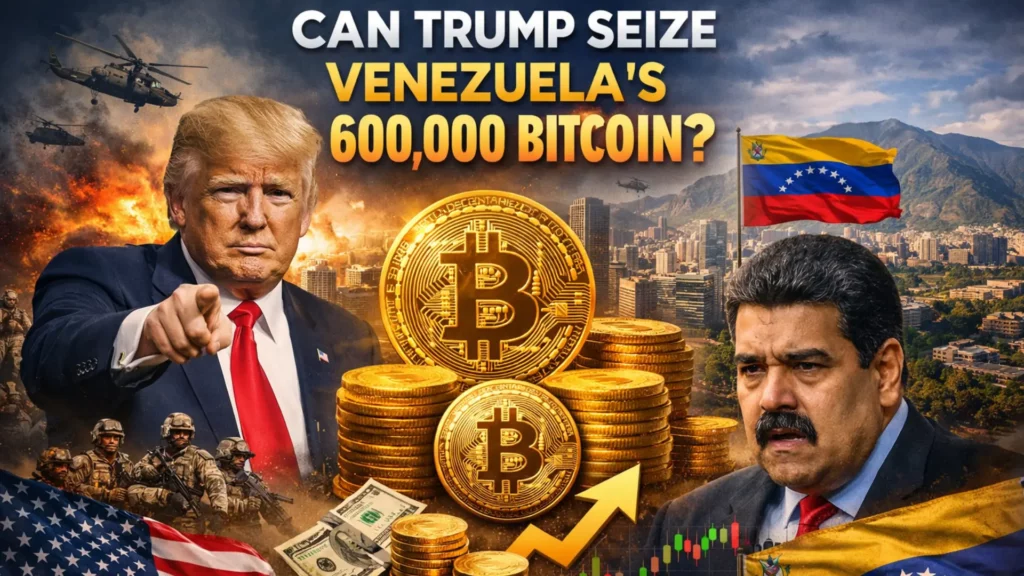
In early 2026, the geopolitical landscape was rocked by dramatic developments involving the United States and Venezuela. After U.S. forces captured Venezuelan President Nicolás Maduro on criminal charges, reports and speculation emerged that Venezuela may have quietly accumulated a massive Bitcoin reserve—estimated at around 600,000 BTC, worth roughly $55–$67 billion at current prices. That has raised an urgent question on markets and states alike: Can former President Donald Trump or the U.S. government actually acquire these Bitcoins, and if so, what would it mean for the U.S. economy?
How Real Is the 600,000 Bitcoin Reserve Claim?
First, it’s important to understand the source and nature of the “Venezuela Bitcoin reserve” claim. Multiple intelligence reports and crypto analytics firms have suggested Venezuela may have built a “Bitcoin Shadow Reserve” of Bitcoin since around 2018 by converting proceeds from gold sales, accepting payments in stablecoins like USDT for oil exports, and accumulating crypto via mining operations. Estimates place this hoard between 600,000 and 660,000 BTC, representing about 3 % of Bitcoin’s total circulating supply.
If accurate, this would make Venezuela one of the largest Bitcoin holders in the world—comparable with institutional whales such as BlackRock and MicroStrategy. However, it’s worth noting that there’s no fully transparent on-chain proof of this exact stash; much of the narrative is derived from intelligence data and indirect sources.
Can the U.S. Legally Seize the Bitcoin?
The simple answer is: in theory, possibly—but in practice, extremely complicated.
Unlike physical assets (like oil fields or tangible financial holdings), Bitcoin presents unique legal and logistical challenges:
1. Sovereign Asset Immunity
Under international law, a nation’s sovereign assets are generally protected from seizure by other states. Even where allegations of criminal activity exist, the standard legal route is through sanctions, freeze orders, or court judgments, not direct appropriation. For example, the U.S. has previously seized Bitcoin tied to criminal activity through legal processes—such as confiscations linked to darknet marketplaces—but those were linked to specific criminal cases with clear evidence of illicit use.
2. Custody and Wallet Access
Even if the U.S. asserted a claim to these assets, gaining control of the private keys is non-trivial. Bitcoin security is decentralized by design: unless the keys are voluntarily surrendered, held in a jurisdiction subject to U.S. authority, or seized in a legitimate law enforcement operation, simply declaring “ownership” is not enough. The current uncertainty about who controls these keys is part of why analysts treat this with caution.
3. Legal Battles and Frozen Holdings
Experts widely expect that, if the U.S. tries to lay claim to such Bitcoin, the assets would most likely be frozen pending litigation for years rather than instantly transferred to American coffers. That could effectively take these coins out of circulation but not make them immediately available to spend or liquidate.
What If the U.S. Did Acquire Bitcoin?
Let’s run a thought experiment: suppose the United States did somehow acquire or control the 600,000 BTC. What might that mean for the economy?
1. Strengthening a Strategic Bitcoin Reserve
One possible scenario is that the U.S. could add these coins to a Strategic Bitcoin Reserve. Currently, the U.S. government holds an estimated 325,000 BTC seized through previous enforcement actions. Combining that with Venezuela’s alleged stash could push total Bitcoin holdings close to one million BTC, a figure some analysts argue would make the U.S. the leading sovereign Bitcoin holder in the world.
This would transform Bitcoin from a purely speculative asset into something more akin to a strategic reserve commodity—a digital parallel to gold holdings. In theory, this could:
- Boost the U.S. dollar’s position in digital finance
- Provide a hedge against inflationary pressures
- Promote broader acceptance of digital assets in mainstream finance
However, such potential benefits are speculative and hinge on legal, regulatory, and political consensus around how to use such a reserve.
2. Impact on Bitcoin Markets
Removing roughly 600,000 BTC from potential trading (especially if frozen) would shrink the effective supply of Bitcoin. Since Bitcoin’s supply is capped at 21 million, taking 3 % of that out of circulation could tighten available liquidity and exert upward pressure on prices—assuming demand remains steady. Historical precedents show that even much smaller moves (like Germany’s sale of 50,000 BTC) have triggered significant price movements.
However, markets could also react negatively to the perception of political interference in crypto markets. A government holding such a vast digital stash could undermine the decentralization ethos central to Bitcoin’s market value.
3. U.S. Fiscal and Monetary Considerations
From a macroeconomic perspective, holding Bitcoin on a sovereign balance sheet has risks and rewards:
- Rewards: Potential value appreciation, diversification away from traditional fiat assets, and leadership in digital financial infrastructure.
- Risks: Extreme volatility (Bitcoin prices can swing wildly), regulatory backlash, and increased geopolitical tension with other nations wary of U.S. control over global crypto assets.
Geopolitical and Ethical Backdrop
It’s crucial to contextualize this within broader geopolitical dynamics. The U.S. action in Venezuela triggered international criticism, with countries like Russia labeling the move as illegal, portraying it as a blend of realpolitik and strategic interest rather than pure legal action.
Moreover, Venezuelan leaders and allied governments vehemently dispute any claims of U.S. control over their resources—be they oil, commodities, or alleged cryptocurrency holdings.
Conclusion: A Theoretical Impact With Real Constraints
The narrative of Donald Trump “acquiring 600,000 Bitcoin” from Venezuela captures headlines and imaginations alike, but the reality is far more nuanced. Legally, politically, and technically, it is far from straightforward for the U.S. to seize and control these assets outright. At best, the U.S. could secure them in a legal limbo that effectively removes them from circulation, potentially supporting higher Bitcoin prices and adding to strategic holdings.
Economically, the implications are mixed: broader crypto influence and hedge potential on one hand, and volatility, geopolitical tension, and legal complexity on the other. Regardless of how the situation unfolds, it underlines the evolving intersection of geopolitics and digital finance—and how emerging assets like Bitcoin are now part of the strategic calculations of nations, not just individual investors.

I am Pawan Kashyap currently living in Amritsar. I always try to grab new things from the cryptocurrency market. From my observations and trends in the market, I always try to provide the best and accurate information in the form of articles from this blog. Follow us on Facebook, Instagram, and Twitter to join us.