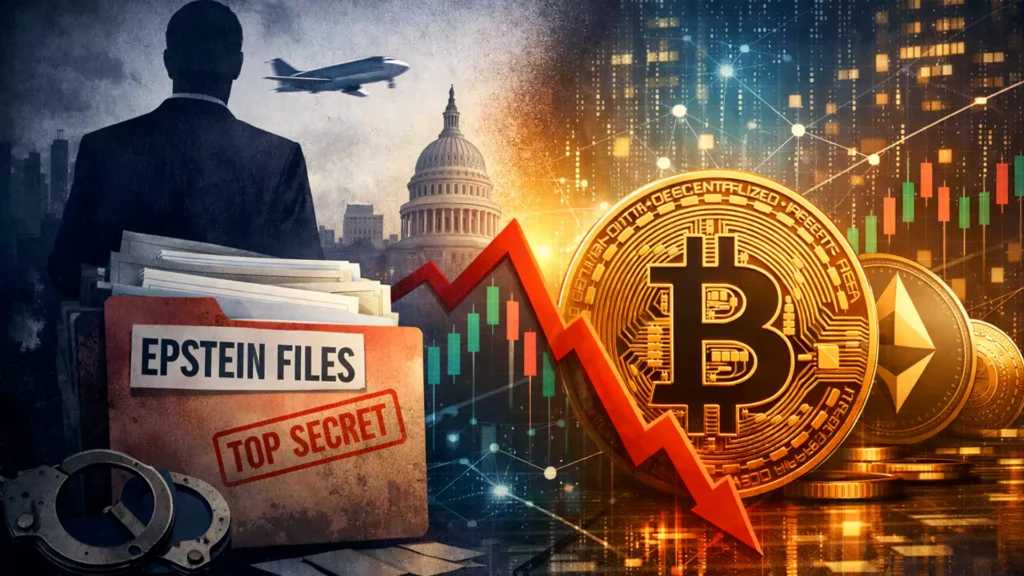
In recent years, the cryptocurrency market has repeatedly proven that it is not driven by fundamentals alone. Narratives, emotions, and global political or social shocks often play a powerful role in price movements. One such emerging narrative is the renewed fear surrounding the so-called “Epstein files” and the speculation about powerful individuals, institutions, and hidden financial networks.
While the Epstein case itself is not directly related to blockchain or digital assets, the fear of exposure, elite panic, and institutional instability have the potential to influence financial markets—including cryptocurrency. For long-term investors, understanding this psychological layer is far more important than reacting to short-term volatility.
Related Article: Is the Epstein Files the Main Reason Behind the Bitcoin Crash?
Why the Epstein Files Narrative Affects Financial Markets
The Epstein files symbolize more than a criminal investigation. In the public mind, they represent:
- Fear of elite exposure
- Distrust in governments and institutions
- Concerns over hidden financial networks
- Potential political and economic instability
Whenever trust in centralized systems weakens, risk perception increases across all asset classes. Markets dislike uncertainty, and crypto—being highly sentiment-driven—often reacts faster and more aggressively.
Connection Between Elite Fear and Cryptocurrency Volatility
Cryptocurrency was built on the idea of decentralization and freedom from centralized control. Ironically, during moments of global fear, crypto can behave in two opposite ways:
- Short-Term Panic Selling
Retail investors may sell risk assets, including crypto, due to fear of regulation, crackdowns, or liquidity shocks. - Long-Term Narrative Strengthening
Distrust in elites and institutions reinforces the original purpose of Bitcoin and blockchain: financial sovereignty and transparency.
This creates temporary volatility but long-term ideological support for decentralized assets.
Psychological Impact on Long-Term Investors
Fear-driven narratives like the Epstein files mainly affect investors at the emotional level. Long-term holders often face three internal conflicts:
- Fear of hidden regulation: Concerns that exposed elites may push stricter financial controls
- Fear of market manipulation: Belief that powerful players could exit or reallocate funds
- Fear of uncertainty: Not knowing how political fallout may affect crypto policies
However, history shows that markets eventually detach from sensational narratives once real economic data takes precedence.
Historical Pattern: Fear vs Fundamentals
From global scandals to wars and banking collapses, crypto has repeatedly faced fear-based sell-offs. Yet long-term trends have always been shaped by:
- Network adoption
- Hash rate growth
- Institutional infrastructure
- Regulatory clarity over time
Short-term fear creates noise. Long-term value follows utility and scarcity, not headlines.
How Long-Term Crypto Investors Should Respond
Instead of reacting emotionally, long-term investors should focus on strategy:
1. Avoid Narrative-Driven Decisions
If the news does not directly affect blockchain technology, adoption, or protocol security, it is likely short-term noise.
2. Revisit Your Investment Thesis
Bitcoin and major cryptocurrencies were designed for trustless systems. Institutional fear indirectly supports this thesis rather than weakening it.
3. Focus on Accumulation Zones
Fear-driven dips often provide better risk-reward opportunities for disciplined investors.
4. Diversify Within Crypto
Holding a mix of Bitcoin, Ethereum, and utility-driven altcoins reduces emotional stress during uncertainty.
Could This Fear Benefit Crypto in the Long Run?
Paradoxically, yes.
Every event that exposes weaknesses in centralized power structures strengthens the philosophical foundation of cryptocurrency. While prices may react negatively in the short term, the long-term narrative of decentralization, transparency, and self-custody becomes stronger.
For patient investors, fear is not a signal to exit—but a reminder of why crypto exists in the first place.
Final Thoughts
The fear surrounding the Epstein files is a sentiment-driven shock, not a structural threat to cryptocurrency. Long-term investors should avoid emotional reactions and stay anchored to fundamentals.
Markets will always move on from headlines. Those who understand the difference between fear and value are the ones who benefit in the long run.

I am Pawan Kashyap currently living in Amritsar. I always try to grab new things from the cryptocurrency market. From my observations and trends in the market, I always try to provide the best and accurate information in the form of articles from this blog. Follow us on Facebook, Instagram, and Twitter to join us.