




In recent years, the world of sovereign finance has been buzzing with talk of digital assets joining national balance sheets. With Bitcoin — often dubbed digital gold — capturing global attention, governments and analysts are increasingly discussing not only formal strategic reserves of cryptocurrencies but also speculative or undisclosed stockpiles sometimes termed shadow reserves. This article unpacks the idea of a Bitcoin shadow reserve and examines which countries are publicly holding Bitcoin and other crypto assets — and which might be doing so behind closed doors.
Understanding the Bitcoin Shadow Reserve
A Bitcoin shadow reserve refers to a large stockpile of Bitcoin held by a country, government entity, or political regime that isn’t openly declared in official financial statements or central bank disclosures. Unlike formal reserves — such as gold or foreign exchange holdings reported in central bank balance sheets — shadow reserves remain undisclosed, unofficial, or opaque, often kept hidden to avoid economic scrutiny, geopolitical consequences, or sanctions risks.
The term gained traction in early 2026 when rumors and intelligence reports suggested Venezuela may have quietly amassed a massive stash of Bitcoin over the years to sidestep international sanctions and preserve economic value outside traditional financial systems. Analysts estimate this alleged reserve could be hundreds of thousands of Bitcoin — valued at tens of billions of dollars, potentially making it one of the largest Bitcoin hoards in the world if verified.
It’s important to emphasize that shadow reserve claims remain speculative. Blockchain intelligence platforms have not confirmed the exact figures or custody details of such hidden holdings, and much of the narrative comes from external analysis rather than transparent disclosure.
How Shadow Reserves Might Be Built
Countries or regimes might accumulate Bitcoin and conceal it through various mechanisms:
1. Converting Commodity Revenues
Some nations with significant natural resources may convert oil, gold, or other export revenues into Bitcoin through intermediaries or stablecoins (like USDT) and eventually into BTC to evade monitoring or sanctions.
2. Mining and Seizures
State-directed mining operations or seizure of illicit mining assets within borders can contribute to accumulating Bitcoin outside conventional reporting channels.
3. Use of Intermediaries and Hidden Wallets
Private keys could be held by trusted insiders and distributed across wallets without official documentation, helping keep large holdings off public fiscal records.
These practices can mask the true scope of Bitcoin holdings and complicate market perceptions about real supply availability.
Public & Formal Bitcoin Reserves: Who Holds What?
While shadow reserves are murky by definition, several countries publicly hold Bitcoin as part of strategic, legal, or seized-asset frameworks. The following are key examples based on the latest estimates:
United States
The U.S. government is the largest known sovereign holder of Bitcoin. Much of its BTC stockpile comes from criminal investigations, seizures, and asset forfeiture — including high-profile cases like Silk Road and ransomware cases.
In 2025, an executive order formally established a Strategic Bitcoin Reserve, where seized Bitcoin is preserved instead of being auctioned off, signaling a shift toward treating BTC as a long-term store of value.
Estimated Holdings: ~198,000–328,000 BTC (with valuations above $20 billion).
China
Despite a public anti-crypto stance, China retains one of the largest Bitcoin hoards derived from major confiscations — such as the PlusToken scam bust — amounting to tens of thousands of BTC.
Status: China’s holdings are not part of a formal strategic reserve; they stem from law enforcement seizures and are not officially recorded as reserve assets.
United Kingdom
The UK holds Bitcoin acquired through anti-money laundering and criminal prosecutions. While not part of a dedicated strategic reserve program, these assets represent one of the larger European sovereign holdings.
Estimated Holdings: ~61,000 BTC.
Bhutan
This small Himalayan kingdom has taken a unique approach by using abundant hydropower to run state-supported Bitcoin mining operations. The result: a Bitcoin reserve worth more than $1 billion for a nation with a relatively small GDP.
Estimated Holdings: ~12,000–13,000 BTC.
El Salvador
A pioneer in national Bitcoin policy — being the first country to adopt Bitcoin as legal tender — El Salvador has also built a formal Bitcoin reserve. While the IMF has conditioned fiscal policies around these holdings, the nation continues to hold thousands of BTC.
Estimated Holdings: ~6,000–7,500 BTC.
Other Countries & Entities
- Ukraine: Estimated to hold tens of thousands of BTC, often tied to wartime crypto fundraising and private donations — with legislative moves exploring formal reserves.
- Finland & Georgia: Small holdings due to criminal asset seizures.
- North Korea: Analysts consider it a major illicit holder via cybertheft, though not officially declared.
- Iran & Kazakhstan: Regulations require miners to sell to central banks or encourage crypto reserves; exact figures remain opaque.
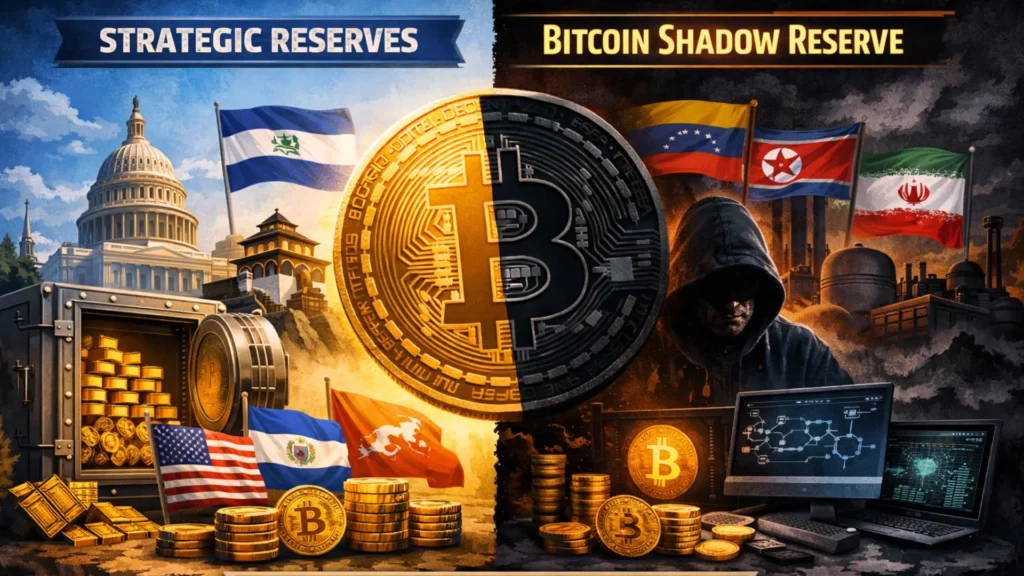
Shadow Reserves vs. Strategic Reserves — Key Differences
| Feature | Strategic Reserve | Shadow Reserve |
|---|---|---|
| Transparency | Publicly reported | Undisclosed / hidden |
| Accounting | Included in official reserves | Not reported in financial statements |
| Purpose | Store of value, hedge or policy tool | Evasion of sanctions / covert hedge |
| Example Countries | U.S., El Salvador, Bhutan | Rumored: Venezuela |
Why Shadow Reserves Matter
If proven real, shadow reserves — especially something as large as the alleged Venezuelan Bitcoin stash — would have major implications:
1. Global Supply Dynamics
Large dormant BTC holdings reduce circulating liquidity, potentially influencing price volatility.
2. Geopolitical Leverage
Hidden crypto assets can provide economic alternatives to sanctioned economies, complicating international financial diplomacy.
3. Regulatory Impacts
Such reserves raise questions about how nations might integrate digital assets into formal reserve frameworks and the need for transparent reporting standards.
Conclusion
The narrative around Bitcoin shadow reserves reflects how state actors might pursue alternative forms of economic resilience or strategic advantage outside traditional reserve systems. While formal strategic Bitcoin holdings — like those in the U.S., El Salvador, and Bhutan — are now public policy tools, shadow reserves remain speculative and opaque.
Whether shadow reserves exist as widely as rumored, they serve as a reminder: in the evolving landscape of digital finance, disclosure, global norms, and transparent accounting will continue to shape how nations interact with decentralized assets.

I am Pawan Kashyap currently living in Amritsar. I always try to grab new things from the cryptocurrency market. From my observations and trends in the market, I always try to provide the best and accurate information in the form of articles from this blog. Follow us on Facebook, Instagram, and Twitter to join us.