
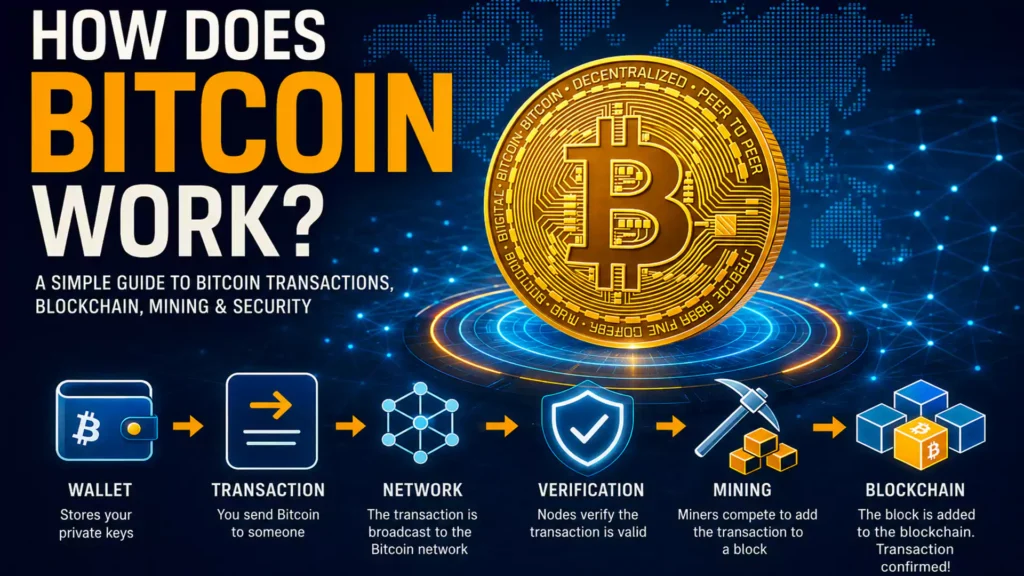
Bitcoin is often described as digital money, a cryptocurrency, or a decentralized payment network. But what actually happens when someone sends Bitcoin to another person?
There is no bank in the middle. No central company maintains a master database of account balances. Instead, Bitcoin combines cryptography, peer-to-peer networking, a public blockchain, economic incentives, and proof of work to create a system in which computers around the world can independently verify the same monetary history.
The basic idea was introduced in Satoshi Nakamoto’s 2008 white paper, Bitcoin: A Peer-to-Peer Electronic Cash System. The proposed system was designed to allow online payments to move directly between participants without requiring a financial institution to process every transaction.
This guide explains how Bitcoin works step by step, starting with the simple version and then going deeper into wallets, transactions, UTXOs, nodes, mining, blocks, proof of work, confirmations, fees, and Bitcoin’s monetary supply.
What Is Bitcoin?
Bitcoin is a decentralized digital monetary network that allows people to transfer units of value over the internet without relying on a central bank or payment processor.
It is useful to distinguish between Bitcoin and bitcoin:
- Bitcoin (capital B) generally refers to the network and protocol.
- bitcoin (lowercase b) generally refers to the monetary unit.
- BTC is the commonly used ticker symbol for bitcoin.
Unlike money held in a bank account, bitcoin is not represented by a central database maintained by one institution. The Bitcoin network maintains a shared transaction history that participating computers can independently verify.
Bitcoin.org describes Bitcoin as a peer-to-peer payment network operating without a central authority, with transactions and issuance managed collectively by the network.
The system has several major components:
- Private keys authorize spending.
- Digital signatures prove authorization.
- Transactions transfer control of bitcoin.
- Nodes independently verify transactions and blocks.
- The blockchain records the accepted transaction history.
- Miners compete to add new blocks.
- Proof of work makes rewriting history computationally expensive.
- Consensus rules determine which transactions and blocks are valid.
Together, these components allow Bitcoin to operate without a central administrator. Click to read more about What is Bitcoin.
How Does Bitcoin Work in Simple Terms?
Imagine Alice wants to send 0.01 BTC to Bob.
The simplified process looks like this:
Alice creates a transaction → Alice signs it with her private key → the transaction is broadcast to the Bitcoin network → nodes verify it → the transaction enters the pool of pending transactions → a miner includes it in a block → the miner finds a valid proof of work → the block is broadcast → nodes verify the block → the block is added to the blockchain → Bob’s transaction receives confirmations.
That’s the basic process.
But there is an important point:
Bitcoin does not actually move physical coins or tokens from one wallet to another.
Instead, Bitcoin transactions change which conditions must be satisfied to spend specific unspent transaction outputs (UTXOs).
Understanding this distinction makes Bitcoin much easier to understand technically.
1. Bitcoin Wallets: Where Bitcoin Begins
A Bitcoin wallet is software or hardware that manages the cryptographic information required to receive and spend bitcoin.
A common misconception is that your bitcoin is physically stored inside your wallet.
It isn’t.
The blockchain records Bitcoin’s transaction history. Your wallet primarily manages the private keys that allow you to authorize transactions spending bitcoin associated with those keys.
Bitcoin.org explains that wallets generate Bitcoin addresses and that private keys are used to sign transactions.
What is a private key?
A private key is secret cryptographic information that gives someone the ability to authorize spending.
It must be protected.
If someone obtains your private key or the seed phrase from which your wallet’s keys are derived, they may be able to spend the associated bitcoin.
There is no Bitcoin customer-service department that can simply reverse an unauthorized transaction.
What is a public key?
A public key is mathematically derived from a private key.
It can be used as part of the mechanism for verifying digital signatures.
The relationship is approximately:
Private key → Public key → Address
The private key remains secret while information derived from it can be shared.
2. What Is a Bitcoin Address?
A Bitcoin address is a destination identifier used to receive bitcoin.
Modern Bitcoin addresses commonly begin with formats such as:
bc1q...bc1p...
Different address types exist because Bitcoin’s transaction scripting and output formats have evolved over time.
An address should generally be treated as a receiving identifier, rather than as an account number containing a balance.
Bitcoin.org recommends using Bitcoin addresses only once when possible, which can improve privacy.
For example, Bob can give Alice a Bitcoin address.
Alice’s wallet then constructs a transaction that creates an output spendable under the conditions associated with Bob’s destination.
3. What Actually Gets Transferred?
This is one of the most important concepts in understanding Bitcoin.
Bitcoin does not maintain conventional balances like:
Alice = 2 BTC
Bob = 1 BTC
Instead, the system tracks unspent transaction outputs, commonly called UTXOs.
A UTXO is an output from a previous transaction that has not yet been spent.
Bitcoin.org’s vocabulary documentation describes the basic model: transactions consume existing UTXOs as inputs and create new UTXOs as outputs.
Simple example
Suppose Alice has:
1 BTC UTXO
She wants to send Bob:
0.3 BTC
Her wallet could create a transaction approximately like this:
Input:
- 1 BTC UTXO
Outputs:
- 0.3 BTC → Bob
- 0.699 BTC → Alice’s change
- 0.001 BTC → miner fee
The original 1 BTC UTXO is consumed.
New outputs are created.
Alice now controls the 0.699 BTC change output, while Bob controls the 0.3 BTC output.
The difference becomes the transaction fee.
4. How a Bitcoin Transaction Is Created
When you press Send in a Bitcoin wallet, several things happen behind the scenes.
Step 1: The wallet selects UTXOs
The wallet identifies spendable UTXOs controlled by the user’s keys.
Step 2: It selects the recipient
The user enters a Bitcoin address or another supported payment destination.
Step 3: The wallet determines the amount
For example:
Send: 0.05 BTC
Step 4: The wallet calculates a transaction fee
Fees compensate miners for including transactions in blocks.
Bitcoin transaction fees are not simply a fixed percentage of the amount being sent. They are generally influenced by transaction size and prevailing demand for block space. Higher-fee transactions can become more attractive to miners when demand is high.
Step 5: The wallet creates outputs
The transaction contains one or more outputs specifying how much bitcoin can be spent under particular conditions.
Step 6: The wallet signs the transaction
The wallet uses the relevant private key to produce a digital signature.
This signature provides cryptographic evidence that the person creating the transaction is authorized to spend the referenced funds.
Step 7: The transaction is broadcast
The transaction is transmitted to Bitcoin nodes over the peer-to-peer network.
5. What Do Bitcoin Nodes Do?
A Bitcoin node is a computer running Bitcoin software that participates in the network.
A full node maintains and verifies Bitcoin’s blockchain according to Bitcoin’s consensus rules.
One of the most important properties of Bitcoin is that nodes do not simply trust miners.
They independently validate blocks and transactions.
Bitcoin Core documentation describes full nodes as independently following the same rules to determine which transactions and blockchain are valid.
This distinction is extremely important.
Miners propose blocks.
Nodes validate blocks.
A miner cannot simply create an invalid transaction and force the network to accept it.
If a block violates consensus rules, nodes can reject it regardless of how much computing power was used to produce it.
6. How Bitcoin Transactions Are Verified
When a transaction reaches a node, the node checks whether it follows Bitcoin’s rules.
Among other things, the network checks whether:
- the referenced inputs exist;
- the inputs have not already been spent;
- the transaction follows Bitcoin’s script rules;
- the required signatures are valid;
- the transaction does not create unauthorized bitcoin;
- the transaction’s arithmetic is valid;
- the transaction follows relevant consensus rules.
If the transaction is valid, nodes can relay it to other nodes.
If it is invalid, nodes reject it.
This decentralized verification process is one of the foundations of Bitcoin.
7. What Is the Bitcoin Mempool?
After a valid transaction is broadcast, it may be held by nodes in their mempool, short for memory pool.
The mempool contains transactions that a node knows about, but that have not yet been included in a confirmed block.
It is useful to think of the mempool as a waiting area.
For example:
Alice sends BTC → transaction is broadcast → nodes verify it → transaction waits in mempool → miner selects it → transaction enters a block.
Different nodes can have somewhat different mempools because transactions propagate through the peer-to-peer network at different times and because node policies can differ.
Therefore, the mempool is not a single global database.
8. Bitcoin Mining: How New Blocks Are Created
Mining is one of Bitcoin’s most misunderstood concepts.
Mining is not simply “creating new Bitcoin.”
Miners perform a critical role in:
- processing transactions;
- constructing candidate blocks;
- competing through proof of work;
- helping establish the chronological order of transactions;
- securing the blockchain.
Bitcoin’s official FAQ describes mining as the process of using computing power to process transactions, secure the network, and synchronize participants.
9. What Is Proof of Work?
Bitcoin uses Proof of Work (PoW) as its block-production mechanism.
A miner constructs a candidate block and repeatedly changes certain data, especially a value called the nonce, while calculating cryptographic hashes.
The goal is to find a block hash that satisfies the network’s current difficulty target.
A simplified representation is:
Block data + nonce → SHA-256 hashing → hash
If the resulting hash does not satisfy the target:
Try another nonce.
This process is repeated enormous numbers of times.
Because cryptographic hashes behave unpredictably, miners cannot reliably calculate the winning nonce in advance.
They must perform repeated attempts.
Bitcoin’s proof-of-work design makes rewriting past blocks increasingly expensive because an attacker would have to redo the work for the altered block and subsequent blocks.
10. Why Does Bitcoin Use Proof of Work?
The biggest problem Bitcoin had to solve was not simply digital payments.
It was the double-spending problem.
With ordinary digital information, copying a file is easy.
If digital money could be copied like a document, someone could theoretically spend the same digital asset twice.
Banks solve this problem by maintaining centralized ledgers.
Bitcoin takes a different approach.
It combines:
Cryptographic signatures + distributed verification + proof of work + economic incentives
to establish which transactions become part of the accepted transaction history.
The original Bitcoin white paper specifically proposed proof of work and a peer-to-peer network as part of the solution to double spending without requiring a trusted financial intermediary.
11. What Is Inside a Bitcoin Block?
A Bitcoin block contains transaction data along with metadata used to connect and secure the blockchain.
Important block-header information includes:
- a reference to the previous block;
- a Merkle root representing the block’s transactions;
- a timestamp;
- the difficulty target representation;
- a nonce.
The previous-block hash creates a connection between blocks.
For example:
Block 100 → Block 101 → Block 102 → Block 103
Block 103 references Block 102.
Block 102 references Block 101.
Block 101 references Block 100.
This creates the chain.
12. Why Is the Blockchain Difficult to Change?
Suppose an attacker changes an old transaction.
Changing the transaction changes the relevant transaction hash.
That affects the Merkle root of the block.
That changes the block’s header hash.
Because the next block references the previous block, the change also breaks the chain relationship with the next block.
The attacker would therefore need to redo the proof of work for the modified block and subsequent blocks and then catch up with the honest chain.
Bitcoin’s developer documentation explains that linking blocks makes modifying historical transactions increasingly difficult because subsequent proof-of-work would also have to be redone.
This is why Bitcoin’s blockchain is often described as tamper-resistant, rather than simply “immutable.”
13. What Is a Merkle Tree?
Bitcoin does not need to put every transaction directly into the block header.
Instead, transactions are organized into a structure called a Merkle tree.
The transaction hashes are combined repeatedly until a single hash—the Merkle root—represents the set of transactions.
Simplified:
Transaction A + Transaction B → Hash AB
Transaction C + Transaction D → Hash CD
Hash AB + Hash CD → Merkle Root
The Merkle root is included in the block header.
If a transaction changes, the resulting Merkle root changes.
The original Bitcoin paper describes the use of Merkle trees to organize transactions and support verification while allowing historical transaction data to be pruned in certain circumstances.
14. How Does a Miner Win?
Imagine thousands of miners competing to produce the next valid block.
Each miner:
- Selects transactions.
- Constructs a candidate block.
- Calculates hashes.
- Changes the nonce and other adjustable information.
- Continues hashing.
- Eventually, one miner finds a valid proof of work.
That miner broadcasts the block.
Other nodes independently verify it.
If valid, they accept it and continue building on top of it.
This resembles a global cryptographic lottery where miners with more computational power have a greater probability of finding the next block.
Importantly, more mining power does not give a miner the ability to arbitrarily change Bitcoin’s consensus rules.
15. What Is Bitcoin Difficulty?
Bitcoin attempts to produce blocks at an average rate of approximately one every ten minutes.
Mining difficulty adjusts periodically so that changes in the amount of total mining power do not permanently make blocks arrive dramatically faster or slower.
If mining power increases substantially, the network adjusts the difficulty upward.
If mining power falls, the difficulty can adjust downward.
Bitcoin’s FAQ explains that difficulty changes automatically to maintain an average block-production interval of about ten minutes.
The ten-minute figure is an average, not a timer.
Two blocks could theoretically be found seconds apart, while another block could take much longer.
16. What Happens When a Miner Finds a Block?
Suppose Miner A finds a valid block.
The miner broadcasts it to the network.
Nodes then verify:
- the proof of work;
- the previous-block reference;
- transactions;
- signatures and scripts;
- block subsidy;
- transaction fees;
- other consensus requirements.
If everything is valid, nodes can add the block to their copy of the blockchain.
Transactions inside the block receive their first confirmation.
The next block built on top provides another confirmation.
The next one provides another.
And so on.
17. What Are Bitcoin Confirmations?
A transaction receives its first confirmation when it is included in a valid block.
If another block is subsequently added on top of that block:
1 confirmation → 2 confirmations
Another:
2 → 3 confirmations
More blocks increase the amount of proof of work accumulated after the transaction.
This is why recipients handling significant amounts may wait for multiple confirmations.
Bitcoin.org notes that even one confirmation can be sufficient for some lower-value transactions, while higher-value transactions may warrant waiting for more confirmations.
The commonly discussed “six confirmations” rule is a practical convention, not a universal Bitcoin protocol requirement.
18. How Does Bitcoin Prevent Double Spending?
Consider this scenario.
Alice has one spendable UTXO worth 1 BTC.
She creates:
Transaction A: Send 1 BTC to Bob.
Then she attempts:
Transaction B: Send the same 1 BTC to Charlie.
Both transactions attempt to spend the same underlying UTXO.
They cannot both become valid confirmed spends of that same UTXO.
Bitcoin nodes and miners follow consensus rules that prevent an already-spent output from being spent again in the confirmed chain.
Proof of work then provides a mechanism for establishing which valid chain becomes the accepted history when competing blocks or transactions create temporary conflicts.
This was one of the central problems addressed by Bitcoin’s original design.
19. Bitcoin Fees: Why Do You Pay a Transaction Fee?
Bitcoin transactions can include fees paid to miners.
The fee is generally the difference between the value of the inputs and the value of the outputs.
For example:
Inputs = 1 BTC
Outputs = 0.999 BTC
Fee = 0.001 BTC
Fees provide an economic incentive for miners to include transactions.
When demand for block space increases, users may compete by offering higher fee rates.
This can increase the cost of getting a transaction confirmed quickly.
Bitcoin’s fee market therefore helps allocate limited block space.
20. What Is the Bitcoin Block Subsidy?
Miners can receive two major forms of reward:
- Block subsidy
- Transaction fees
The block subsidy consists of newly created bitcoin.
It is not created by a central bank.
It is generated according to Bitcoin’s consensus rules and awarded through the coinbase transaction of a valid block.
As of 2026, the block subsidy is 3.125 BTC per block, following the April 2024 halving. The next halving is expected around 2028, when the subsidy will fall to 1.5625 BTC.
21. How Does Bitcoin’s 21 Million Supply Limit Work?
Bitcoin has a predetermined issuance schedule.
The block subsidy started at 50 BTC in 2009.
It is cut in half every 210,000 blocks, approximately every four years.
The sequence is roughly:
| Period | Block Subsidy |
|---|---|
| 2009 | 50 BTC |
| 2012 | 25 BTC |
| 2016 | 12.5 BTC |
| 2020 | 6.25 BTC |
| 2024 | 3.125 BTC |
| ~2028 | 1.5625 BTC |
| Later | Continues decreasing |
Eventually, new issuance approaches zero.
Bitcoin’s protocol is designed around a maximum supply of approximately 21 million BTC.
This predictable issuance is one of Bitcoin’s defining monetary characteristics.
22. What Happens After All Bitcoin Is Mined?
Bitcoin mining does not necessarily disappear when the block subsidy reaches zero.
Instead, miners can continue earning transaction fees.
The original Bitcoin design anticipated that the mining incentive would eventually transition from newly created coins toward transaction fees.
Therefore:
Today:
Block subsidy + transaction fees → miner revenue
Eventually:
Transaction fees → miner revenue
Mining remains important because proof of work continues to provide Bitcoin’s block-production and security mechanism.
23. Is Bitcoin Anonymous?
Bitcoin is generally not anonymous in the traditional sense.
It is better described as pseudonymous.
Bitcoin’s blockchain is public.
Anyone can inspect transaction history and see:
- transaction IDs;
- addresses;
- amounts;
- block information;
- movement between addresses.
What the blockchain does not automatically provide is a person’s real-world identity next to every address.
However, identities can sometimes be associated with addresses through exchanges, businesses, blockchain analysis, leaked information, reused addresses, or other data.
Therefore, the statement:
“Bitcoin transactions are completely anonymous”
is misleading.
The public nature of the blockchain can actually make certain transaction histories highly traceable.
24. Why Can’t Someone Just Change the Bitcoin Blockchain?
A common misconception is that Bitcoin is secure because the blockchain is stored on one giant server.
It isn’t.
Copies of the blockchain are maintained across many participating nodes.
An attacker cannot simply log into a central Bitcoin database and edit a transaction.
To alter confirmed history, an attacker would need to create an alternative chain that satisfies Bitcoin’s rules and compete against the honest network’s accumulated proof of work.
The more blocks added after a transaction, the more work would generally be required to replace that history.
This does not mean attacks are mathematically impossible under every imaginable condition. It means Bitcoin is designed so that attacking its historical consensus becomes economically and computationally difficult.
25. Can Miners Change Bitcoin’s Rules?
No—not simply because they are miners.
This distinction is essential.
Bitcoin’s consensus rules are enforced by validating nodes.
A miner could construct a block that violates a rule, but nodes following the relevant consensus rules can reject that block.
Bitcoin.org explains that Bitcoin Core nodes independently evaluate blocks and transactions according to the same rules rather than relying on a centralized voting authority.
Miners have influence because they produce blocks, but they do not have unilateral authority over Bitcoin’s consensus rules.
26. Who Controls Bitcoin?
There is no single Bitcoin CEO, central bank, or company controlling the Bitcoin network.
Bitcoin’s operation is distributed across several groups:
Users
Users hold and transact with bitcoin.
Wallet developers
Wallet software helps users manage keys and construct transactions.
Full nodes
Nodes verify transactions and enforce consensus rules.
Miners
Miners perform proof of work and produce blocks.
Developers
Developers propose, review, and implement software changes.
Businesses and exchanges
Businesses provide services around the Bitcoin ecosystem.
None of these groups alone owns Bitcoin.
Bitcoin.org states that protocol changes are proposed publicly and require broad adoption by participants rather than being imposed by one individual or organization.
27. What Is Bitcoin’s Consensus Mechanism?
Bitcoin’s consensus mechanism is the combination of:
Consensus rules + node validation + proof-of-work-based block selection
Every validating node can independently determine whether a transaction or block is valid.
When competing valid chains exist, Bitcoin’s protocol uses the chain with the greatest accumulated proof of work as the authoritative chain under its consensus rules.
This is sometimes casually described as the “longest chain,” but the most-work chain is the more precise concept.
28. Why Is Proof of Work Important for Security?
Imagine someone wants to rewrite a transaction buried under many blocks.
They cannot simply edit the transaction.
They must construct an alternative history and perform the required proof of work for the modified block and the blocks that follow.
Meanwhile, honest miners continue extending the existing chain.
The attacker therefore faces a race.
If the attacker does not control enough mining power, the honest chain can continue increasing its accumulated proof of work faster than the attacker’s alternative chain.
This is one reason confirmations become increasingly valuable as more blocks are added.
Bitcoin’s developer documentation specifically identifies this relationship between chained blocks and the increasing cost of rewriting history.
29. What Is a 51% Attack?
A so-called 51% attack generally refers to an attacker controlling a majority of the network’s mining hash power.
This would give the attacker substantial ability to reorganize recent transaction history under certain conditions.
However, even majority mining power does not give the attacker unlimited powers.
For example, it does not simply allow the attacker to:
- create unlimited bitcoin;
- spend someone else’s coins without the required authorization;
- ignore node-enforced consensus rules.
A majority miner could potentially reorganize blocks and perform certain forms of double spending against transactions under attack conditions.
The economic and practical consequences of such an attack would depend on many factors.
30. Bitcoin’s Security Is Based on Multiple Layers
It is incorrect to say that Bitcoin is secure simply because it uses blockchain technology.
Bitcoin’s security comes from several mechanisms working together:
Cryptography
Protects private keys and digital signatures.
Peer-to-peer networking
Allows information to propagate without a central server.
Node validation
Allows participants to independently enforce consensus rules.
Proof of work
Makes block production costly and historical rewriting difficult.
Economic incentives
Reward miners for participating honestly.
Transparency
Allows the public blockchain to be independently inspected.
Decentralization
Reduces dependence on one central authority.
The combination is more important than any individual component.
31. A Complete Bitcoin Transaction Example
Let’s put everything together.
Suppose Alice wants to send Bob 0.1 BTC.
Step 1: Bob generates an address
Bob’s wallet generates a receiving address.
Step 2: Bob gives Alice the address
Alice enters the address into her wallet.
Step 3: Alice’s wallet finds UTXOs
Suppose Alice controls a UTXO worth 0.15 BTC.
Step 4: Alice creates the transaction
The transaction spends the 0.15 BTC UTXO.
It creates:
Bob: 0.1 BTC
Alice’s change: 0.049 BTC
Miner fee: 0.001 BTC
Step 5: Alice signs it
Her wallet uses the relevant private key to authorize the transaction.
Step 6: The transaction is broadcast
Nodes receive the transaction.
Step 7: Nodes validate it
They check the transaction’s signatures, inputs, outputs and other rules.
Step 8: The transaction enters mempools
It waits to be included in a block.
Step 9: A miner selects it
A miner places the transaction into a candidate block.
Step 10: The miner performs proof of work
The miner repeatedly hashes candidate block headers until finding a valid proof.
Step 11: The miner broadcasts the block
Other nodes receive it.
Step 12: Nodes validate the block
They independently verify the proof of work and every relevant transaction.
Step 13: The block becomes part of the blockchain
Bob’s transaction now has its first confirmation.
Step 14: More blocks follow
Each subsequent block adds another confirmation.
This entire process can occur without Alice, Bob, or the miner needing permission from a bank.
32. Why Bitcoin Is Different From a Bank
A traditional banking system generally looks like:
Customer → Bank → Banking ledger → Bank → Recipient
Bitcoin is closer to:
User → Signed transaction → Peer-to-peer network → Nodes → Miner → Blockchain → Recipient
The difference is not merely technological.
The trust model is different.
In a bank:
“Trust the institution to maintain the ledger.”
In Bitcoin:
“Verify the rules and cryptographic evidence.”
This is one of the fundamental ideas behind Bitcoin.
33. Bitcoin Does Not Require Everyone to Trust Everyone
Bitcoin’s design does not assume that every participant is honest.
Instead, it assumes participants may be adversarial.
A node does not need to trust a transaction simply because another computer sent it.
It verifies the transaction.
A node does not need to trust a miner simply because the miner produced a block.
It verifies the block.
A user does not need to trust one centralized database to know Bitcoin’s history.
The user can use software that independently verifies the relevant blockchain data.
This is often described as trust minimization rather than “trustlessness.”
34. Why Bitcoin Is Called Decentralized
Bitcoin’s decentralization comes from the fact that control is distributed across independent participants.
There is no single server whose shutdown would automatically shut down the network.
There are many nodes.
There are many miners.
There are many users.
There are multiple software implementations and supporting services.
However, decentralization is not binary.
Different parts of the ecosystem can become more or less concentrated over time.
For example, mining can become economically concentrated because specialized hardware, electricity costs, infrastructure, and economies of scale matter.
Therefore, “decentralized” does not mean “every participant has exactly equal power.”
It means there is no single central authority with unilateral control over the entire Bitcoin system.
35. What Happens If You Lose Your Bitcoin Wallet?
If a wallet is lost but the private keys or recovery seed can be restored, the bitcoin can generally still be accessed.
But if the private keys are permanently lost, the associated bitcoin may become effectively unspendable.
This highlights another important principle:
Bitcoin gives users control, but control also creates responsibility.
If you hold your own keys, you are responsible for protecting them.
There is no central Bitcoin company that maintains a master list of everyone’s private keys.
36. Why Bitcoin Can Be Divided Into Smaller Units
One bitcoin can be divided into smaller units called satoshis.
The smallest standard unit is:
1 BTC = 100,000,000 satoshis
Therefore:
0.00000001 BTC = 1 satoshi
This allows Bitcoin to represent very small amounts without requiring whole bitcoins for everyday transactions.
37. Bitcoin and the Blockchain Are Not Exactly the Same Thing
The terms are often used interchangeably, but they are different.
Bitcoin is the broader monetary network and protocol.
Blockchain is the ordered chain of blocks containing Bitcoin’s accepted transaction history.
Saying:
“Bitcoin is a blockchain”
is a simplification.
A better explanation is:
Bitcoin uses a blockchain as part of its decentralized consensus system.
The blockchain alone does not create Bitcoin’s security.
The security comes from the combination of cryptography, consensus rules, nodes, proof of work, networking, incentives, and economic costs.
38. Bitcoin’s Complete Architecture at a Glance
You can understand the entire Bitcoin system as a series of connected layers:
1. Private Keys
Authorize spending.
↓
2. Digital Signatures
Prove authorization.
↓
3. Transactions
Specify how existing UTXOs are spent and what new outputs are created.
↓
4. Peer-to-Peer Network
Broadcasts transactions and blocks.
↓
5. Nodes
Validate transactions and blocks.
↓
6. Mempool
Temporarily holds valid but unconfirmed transactions.
↓
7. Miners
Select transactions and construct candidate blocks.
↓
8. Proof of Work
Makes block production computationally costly.
↓
9. Blockchain
Records the accepted sequence of blocks.
↓
10. Confirmations
Additional blocks increase the accumulated proof of work behind a transaction.
This is the core architecture that makes Bitcoin work.
39. The Three Most Important Ideas to Remember
If all of the technical details seem overwhelming, remember these three ideas.
1. Bitcoin is a distributed ledger
Instead of one bank maintaining the transaction history, many independent computers can verify the blockchain.
2. Private keys authorize spending
Your bitcoin is not physically stored in your wallet. Your wallet manages cryptographic keys that allow you to authorize transactions spending associated UTXOs.
3. Proof of work secures the transaction history
Miners compete to produce blocks, while proof of work makes producing and rewriting blockchain history expensive.
Together, these concepts explain most of Bitcoin.
Frequently Asked Questions About How Bitcoin Works
Bitcoin allows users to transfer value using digitally signed transactions that are verified by decentralized nodes and recorded into a proof-of-work-secured blockchain.
Bitcoin is represented by transaction outputs recorded on the blockchain. Wallets store and manage the private keys needed to spend those outputs.
Bitcoin nodes independently verify transactions according to the network’s consensus rules.
Miners select valid transactions and compete to add new blocks using proof of work.
A transaction can be broadcast almost immediately, but confirmation requires inclusion in a block. Bitcoin targets an average block interval of roughly 10 minutes, although actual confirmation times vary.
Confirmed Bitcoin transactions are generally designed to be difficult to reverse. A transaction can become increasingly difficult to reorganize as additional blocks are built on top of it.
Block space is limited. When demand for confirmation exceeds available space, users can compete through higher fee rates for inclusion.
Under Bitcoin’s current consensus rules, the monetary supply is designed to be capped at approximately 21 million BTC.
Mining is the mechanism through which new bitcoin enters circulation according to the protocol’s issuance schedule. But miners also process transactions and secure the network.
No. Bitcoin’s blockchain is public and transactions can often be traced. Bitcoin is better described as pseudonymous than completely anonymous.
Miners cannot simply spend coins belonging to other people because valid transactions require the appropriate authorization. Mining power provides influence over block production, not ownership of everyone else’s bitcoin.
The Bitcoin protocol itself does not require a bank to validate or settle transactions. However, banks and financial businesses can still interact with Bitcoin as custodians, payment providers, investment businesses, or financial intermediaries.
Final Thoughts: How Does Bitcoin Really Work?
At first glance, Bitcoin can seem complicated because it combines several technologies and economic concepts.
But its fundamental process is surprisingly logical:
Users control private keys → wallets create signed transactions → transactions are broadcast across a peer-to-peer network → nodes verify them → miners package transactions into blocks → proof of work makes block production costly → nodes verify the blocks → valid blocks become part of the blockchain → subsequent blocks provide additional confirmations.
The system does not depend on one central company maintaining the truth.
Instead, Bitcoin distributes verification among participants and uses cryptography, consensus rules, proof of work, and economic incentives to coordinate a shared monetary history.
That is the fundamental innovation behind Bitcoin.
It is not simply a digital coin.
It is a system for maintaining a public, decentralized and independently verifiable ledger of value without requiring a central authority to operate the ledger.
For readers who want to go deeper, the next concepts to study are Bitcoin UTXOs, Bitcoin wallets and private keys, Bitcoin mining, proof of work, Bitcoin nodes, Bitcoin transaction fees, Bitcoin halving, and the Bitcoin Lightning Network. These topics build naturally on the foundation explained in this guide.

I am Pawan Kashyap currently living in Amritsar. I always try to grab new things from the cryptocurrency market. From my observations and trends in the market, I always try to provide the best and accurate information in the form of articles from this blog. Follow us on Facebook, Instagram, and Twitter to join us.