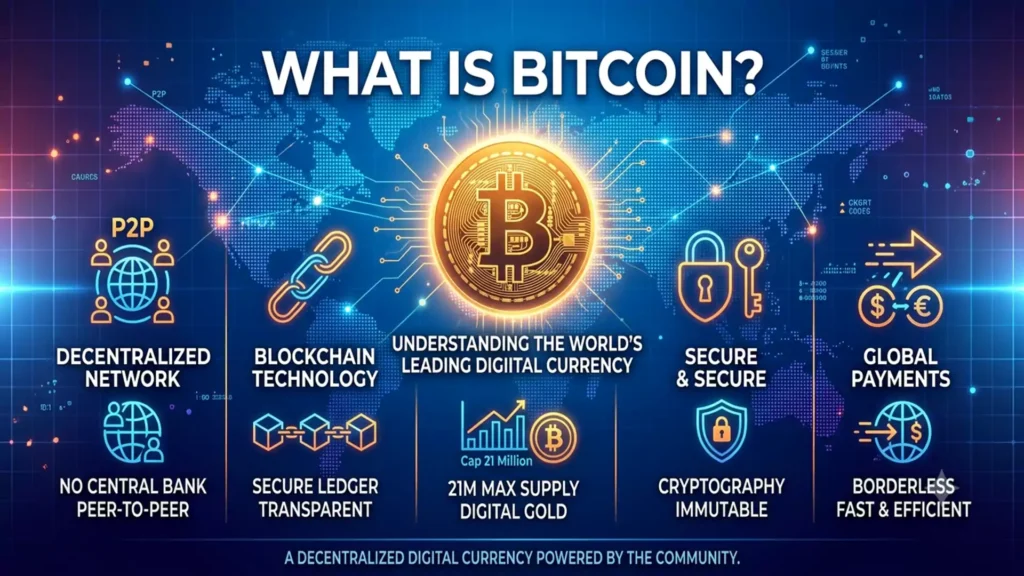
Bitcoin is a decentralized digital currency that allows people to send and receive value over the internet without relying on a bank, government, or other central intermediary.
Unlike traditional currencies such as the U.S. dollar or euro, Bitcoin is not issued or controlled by a central bank. Instead, its network uses cryptography, a public blockchain, economic incentives, and a consensus mechanism called proof-of-work to maintain a shared record of transactions.
Bitcoin was introduced in 2008 by the pseudonymous creator Satoshi Nakamoto and its network launched in January 2009. More than a decade later, Bitcoin has evolved from an experimental peer-to-peer payment system into a globally traded digital asset and an important part of the broader cryptocurrency market.
But what exactly is Bitcoin, how does it work, and why does it have value?
Let’s break it down.
What Is Bitcoin?
Bitcoin is a decentralized peer-to-peer digital currency and payment network.
The word “Bitcoin” can refer to two related things:
- Bitcoin (BTC): the digital asset or monetary unit.
- Bitcoin network: the decentralized network of computers that maintains and validates Bitcoin transactions.
The network operates without a central authority. Instead, thousands of independent computers called nodes participate in maintaining and verifying the Bitcoin blockchain.
Bitcoin’s design allows users to transfer BTC directly between digital wallets. Transactions are recorded on a public ledger known as the Bitcoin blockchain, allowing participants to independently verify the history of transactions.
The Bitcoin project describes the system as a peer-to-peer payment network operating without a central authority or bank. Its software and design are publicly available, allowing anyone to inspect the protocol and participate in the network.
In simple terms:
Bitcoin is digital money designed to operate without a central operator.
Who Created Bitcoin?
Bitcoin was created by a person or group using the name Satoshi Nakamoto.
In October 2008, Nakamoto published the Bitcoin white paper, titled Bitcoin: A Peer-to-Peer Electronic Cash System. The document described a system for transferring digital value directly between participants while addressing the problem of preventing the same digital unit from being spent twice.
The Bitcoin network subsequently launched in January 2009.
Nakamoto continued communicating with early Bitcoin developers and users during Bitcoin’s initial development but eventually disappeared from public involvement. Bitcoin.org states that Nakamoto left the project in late 2010 without revealing much about their identity.
Nakamoto’s real-world identity remains unconfirmed.
Importantly, Bitcoin does not have a CEO or traditional corporate headquarters controlling the network today. Development is open-source, while the network itself is maintained by independent participants.
How Does Bitcoin Work?
At first glance, Bitcoin can seem complicated. Its core operation, however, can be understood through a few important components:
- Bitcoin wallets
- Public and private keys
- Transactions
- The blockchain
- Bitcoin nodes
- Miners
- Proof-of-work
- Network consensus
1. Bitcoin Wallets
A Bitcoin wallet allows users to interact with their BTC.
A wallet does not technically “store” bitcoins in the same way a physical wallet stores cash. Bitcoin ownership is represented through control of cryptographic keys that allow a user to authorize transactions.
A wallet can generate and manage:
- Public addresses
- Private keys
- Transaction information
A public address can be shared with someone who wants to send you Bitcoin.
A private key, however, must remain confidential. Whoever controls the private key can generally authorize transactions involving the associated Bitcoin.
This is why Bitcoin security ultimately depends heavily on protecting private keys and recovery information.
2. Bitcoin Transactions
When someone sends Bitcoin, their wallet creates a transaction that specifies where the BTC is being sent and how much is being transferred.
The transaction is digitally signed using the sender’s private key.
The transaction is then broadcast to the Bitcoin network.
Nodes independently check whether the transaction follows Bitcoin’s rules before it can become part of the blockchain.
3. The Blockchain
The Bitcoin blockchain is a public, chronological record of transactions.
Transactions are grouped into blocks. Each new block references the previous block, creating a chain of blocks.
This structure makes altering historical records extremely difficult because changing an earlier transaction would require reconstructing subsequent proof-of-work and overcoming the economic and computational security of the network.
Bitcoin Core’s validation system independently checks blocks against Bitcoin’s consensus rules, including rules governing the maximum supply and transaction validity.
4. Bitcoin Nodes
A Bitcoin node is a computer running Bitcoin software that participates in validating and relaying network information.
Nodes help enforce Bitcoin’s rules.
For example, a fully validating node can reject a block containing transactions that violate the protocol.
This distinction is important: miners produce blocks, but nodes independently validate them.
That helps prevent miners from simply changing Bitcoin’s rules on their own. Read the complete guide on How Does Bitcoin Works.
What Is Bitcoin Mining?
Bitcoin mining is the process used to add new blocks to the blockchain and secure the network.
Miners compete to solve a computational puzzle based on a cryptographic hash function.
The process is known as proof-of-work.
When a miner successfully produces a valid block, that block can be broadcast to the network. Other nodes verify it, and if it follows the consensus rules, it becomes part of the blockchain.
Mining therefore performs two major functions:
- It helps secure the Bitcoin network.
- It provides the mechanism through which new BTC enters circulation.
Miners receive rewards for successfully producing blocks. The reward consists of newly issued Bitcoin plus transaction fees included in the block.
Because Bitcoin’s issuance schedule is predetermined, mining does not allow miners to create unlimited BTC.
What Is Bitcoin’s Maximum Supply?
One of Bitcoin’s most distinctive characteristics is its limited supply.
The Bitcoin protocol is designed around a maximum supply of approximately 21 million BTC.
New Bitcoin is introduced through block rewards, but the amount issued through the block subsidy decreases over time.
This reduction is known as the Bitcoin halving.
Bitcoin’s protocol reduces the block subsidy by approximately half every 210,000 blocks, or roughly every four years.
The supply schedule is therefore fundamentally different from fiat currencies, where central banks can change monetary policy and expand or contract the money supply.
Bitcoin’s fixed issuance is one of the primary reasons it is often described as a scarce digital asset.
However, limited supply does not automatically guarantee a higher price. Bitcoin’s market value is ultimately determined by supply and demand, and its price can rise or fall dramatically.
Why Does Bitcoin Have Value?
Bitcoin has no physical form and is not backed by a government.
So why does it have value?
The answer involves several characteristics.
Scarcity
Bitcoin’s supply is limited by its protocol.
Decentralization
No single company or government controls the Bitcoin network.
Security
Bitcoin uses cryptography and proof-of-work to protect its transaction history.
Portability
Bitcoin can be transferred across borders using an internet-connected wallet.
Divisibility
One Bitcoin can be divided into very small units. The smallest standard unit is called a satoshi, equal to 0.00000001 BTC.
Verifiability
Bitcoin transactions can be independently verified using the public blockchain.
Network Effect
Bitcoin has developed a large global ecosystem of users, developers, miners, businesses, exchanges, custodians, and financial products.
Together, these properties contribute to Bitcoin’s perceived utility and value.
However, Bitcoin’s value is not guaranteed. Its price remains highly volatile and can be affected by market sentiment, regulation, liquidity, macroeconomic conditions, technological developments, and investor demand.
Bitcoin vs. Traditional Money
Bitcoin differs from traditional fiat currencies in several important ways.
| Feature | Bitcoin | Traditional Fiat Currency |
|---|---|---|
| Issuer | Decentralized protocol | Central bank/government system |
| Physical form | Digital | Digital and/or physical |
| Maximum supply | Approximately 21 million BTC | No fixed universal cap |
| Transactions | Peer-to-peer network | Banks/payment networks |
| Monetary policy | Protocol-defined issuance | Central-bank policy |
| Settlement | Bitcoin blockchain | Banking/payment infrastructure |
| Central authority | No central operator | Central institutions |
| Availability | Global network | Depends on financial infrastructure |
This doesn’t mean Bitcoin necessarily replaces traditional currencies.
Bitcoin and fiat currencies serve different roles and operate within different systems.
What Can Bitcoin Be Used For?
Bitcoin was initially designed around the idea of electronic peer-to-peer payments.
Today, its use cases have expanded.
Payments
People can use Bitcoin to send value to other Bitcoin addresses without directly using a traditional bank.
International Transfers
Bitcoin can potentially move across borders without requiring the same correspondent banking infrastructure used by conventional international transfers.
However, fees, confirmation times, exchange rates, and local regulations can affect its usefulness for payments.
Investment and Speculation
Many people buy Bitcoin as an investment or speculative asset.
Its price history has attracted investors seeking exposure to the cryptocurrency market, although Bitcoin can experience significant price volatility and investors can lose money.
Store of Value
Some Bitcoin proponents view BTC as a potential long-term store of value because of its limited supply and decentralized monetary system.
Whether Bitcoin fulfills this role consistently remains a matter of debate.
Institutional Exposure
Bitcoin has also become accessible through regulated financial products in some jurisdictions.
For example, in January 2024, the U.S. Securities and Exchange Commission approved the listing and trading of several spot Bitcoin exchange-traded products. The SEC emphasized that the decision concerned the specific ETP listings and did not constitute an endorsement of Bitcoin itself.
This development significantly expanded the ways some traditional investors could gain exposure to Bitcoin without directly holding BTC.
What Is Bitcoin Halving?
Bitcoin halving is a programmed reduction in the number of new bitcoins created through mining.
Approximately every 210,000 blocks, the block subsidy is cut in half.
The first block subsidy was 50 BTC. Subsequent halvings reduced it to 25 BTC, then 12.5 BTC, and later 6.25 BTC. The April 2024 halving reduced the subsidy again to 3.125 BTC per block.
The purpose is not to create an artificial market event. Rather, halving is part of Bitcoin’s predetermined monetary issuance schedule.
Historically, Bitcoin halvings have attracted considerable market attention because they reduce the rate at which new BTC enters circulation.
However, investors should not assume that a halving automatically causes Bitcoin’s price to rise.
Is Bitcoin Anonymous?
Bitcoin is often described as anonymous, but that description is misleading.
Bitcoin transactions are generally pseudonymous, not completely anonymous.
The blockchain publicly records transaction information, including Bitcoin addresses and amounts associated with transactions.
A Bitcoin address does not automatically reveal the real-world identity of its owner. However, blockchain analysis and information from exchanges or other services can sometimes connect addresses with individuals or organizations.
Therefore, Bitcoin should not be considered a completely private payment system.
Users who require strong financial privacy should understand the distinction between anonymity, pseudonymity, and transaction transparency.
Is Bitcoin Safe?
The Bitcoin protocol itself has been designed with multiple security mechanisms, but using Bitcoin safely involves more than relying on the network.
There are several different risks.
Private-Key Risk
If someone obtains your private keys or recovery phrase, they may be able to control your funds.
Exchange Risk
Holding Bitcoin through a centralized exchange introduces counterparty and platform risks.
Market Risk
Bitcoin’s price can fluctuate significantly.
Scam Risk
Fake investment platforms, phishing attacks, fraudulent giveaways, impersonation scams, and malicious wallet software can result in financial losses.
Regulatory Risk
Cryptocurrency regulations differ substantially between countries and can change over time.
Bitcoin’s network security therefore should not be confused with the safety of every service built around Bitcoin.
What Are the Main Advantages of Bitcoin?
Bitcoin’s major potential advantages include:
- Decentralized operation
- Limited supply
- Global accessibility
- Peer-to-peer transfers
- Publicly verifiable transactions
- Resistance to unauthorized changes to the ledger
- Open-source development
- Divisibility
- Ability to operate without a traditional bank account
These characteristics have made Bitcoin fundamentally different from conventional financial systems.
What Are the Disadvantages and Risks?
Bitcoin also has important limitations.
Price Volatility
Bitcoin can experience large price movements in relatively short periods.
Energy Consumption
Bitcoin’s proof-of-work system requires substantial computational activity and therefore consumes significant amounts of electricity. The environmental impact of this energy use depends partly on the sources of electricity used by miners.
Transaction Limitations
Bitcoin’s base layer has limited transaction throughput compared with some centralized payment systems.
User Responsibility
Bitcoin can provide users with greater control over their funds, but that control also creates responsibility. Losing private-key access can mean losing access to funds.
Regulatory Uncertainty
Governments around the world continue to develop different approaches to Bitcoin and other digital assets.
Irreversible Transactions
Once a Bitcoin transaction has been sufficiently confirmed, reversing it through the network is generally not possible in the same way a bank can reverse certain payments.
These risks are important for anyone considering buying, holding, or using Bitcoin.
Bitcoin vs. Other Cryptocurrencies
Bitcoin was the first successful decentralized cryptocurrency, but it is not the only digital asset.
Other networks have different designs and objectives.
For example:
- Ethereum focuses heavily on programmable blockchain applications and smart contracts.
- Solana is designed around high-throughput blockchain applications.
- Stablecoins attempt to maintain relatively stable values against assets such as the U.S. dollar.
- Other cryptocurrencies use different consensus mechanisms, governance models, supply structures, and technical architectures.
Bitcoin’s primary identity remains closely connected to decentralized money, monetary scarcity, and censorship-resistant value transfer.
Is Bitcoin a Currency, Investment, or Technology?
Bitcoin can be viewed from several perspectives.
As a currency: it can be used to transfer value.
As a technology: it introduced a decentralized method for maintaining a shared digital ledger without a central administrator.
As an asset: it is traded globally and can be held as an investment.
As a monetary experiment: it tests whether a scarce digital asset can operate independently of traditional monetary authorities.
These perspectives are not mutually exclusive.
Understanding Bitcoin requires looking beyond its price and examining the economic and technological system underneath it.
The Future of Bitcoin
Bitcoin’s future remains uncertain.
Its continued development will depend on factors including adoption, regulation, technological innovation, security, mining economics, institutional participation, and global demand.
The growth of financial products providing Bitcoin exposure has brought the asset into closer contact with traditional financial markets. At the same time, Bitcoin continues to face criticism over volatility, energy consumption, scalability, and its suitability as a payment system.
The most important question may not be whether Bitcoin completely replaces traditional money.
Instead, Bitcoin’s long-term significance could depend on whether it establishes itself as a durable alternative form of digital ownership and monetary infrastructure.
Frequently Asked Questions About Bitcoin
Bitcoin is a decentralized digital currency that allows people to transfer value over the internet without relying on a central bank or payment intermediary.
No single person owns the Bitcoin network. Bitcoin is maintained by a decentralized ecosystem of users, nodes, miners, developers, businesses, and other participants.
Bitcoin was introduced by the pseudonymous developer or group known as Satoshi Nakamoto.
The Bitcoin protocol is designed around a maximum supply of approximately 21 million BTC.
Yes. Bitcoin can generally be exchanged for fiat currencies through cryptocurrency exchanges and other services, depending on the laws and services available in a user’s jurisdiction.
Bitcoin’s legal and regulatory status varies by country. Users should check the rules applicable in their jurisdiction.
There is no universally correct answer. Bitcoin is a highly volatile asset, and its price can decline substantially. Anyone considering Bitcoin should understand the risks and conduct independent research before investing.
The Bitcoin network is protected by cryptography, proof-of-work, and decentralized validation. However, individual wallets, exchanges, devices, and accounts can be compromised. Many losses associated with Bitcoin result from security failures outside the underlying blockchain.
Final Thoughts
Bitcoin represents a fundamental change in how digital value can be created, transferred, and verified.
Its most important innovation is not simply that it created a digital coin. Bitcoin demonstrated how a decentralized network could maintain a shared financial ledger without requiring a central authority to approve every transaction.
Its combination of cryptography, proof-of-work, decentralized validation, predictable issuance, and a public blockchain created a monetary system unlike traditional banking infrastructure.
Whether Bitcoin ultimately becomes a global form of digital money, a long-term store of value, a financial asset, or something else remains uncertain.
What is clear is that Bitcoin has already changed the conversation around money, ownership, financial intermediaries, and digital scarcity.
For anyone entering cryptocurrency, understanding Bitcoin is the logical starting point—because many of the concepts that define the broader crypto industry, including wallets, blockchain transactions, mining, consensus, private keys, and digital assets, can be traced back to Bitcoin’s original design.
This article is for educational purposes only and should not be considered financial or investment advice.

I am Pawan Kashyap currently living in Amritsar. I always try to grab new things from the cryptocurrency market. From my observations and trends in the market, I always try to provide the best and accurate information in the form of articles from this blog. Follow us on Facebook, Instagram, and Twitter to join us.