





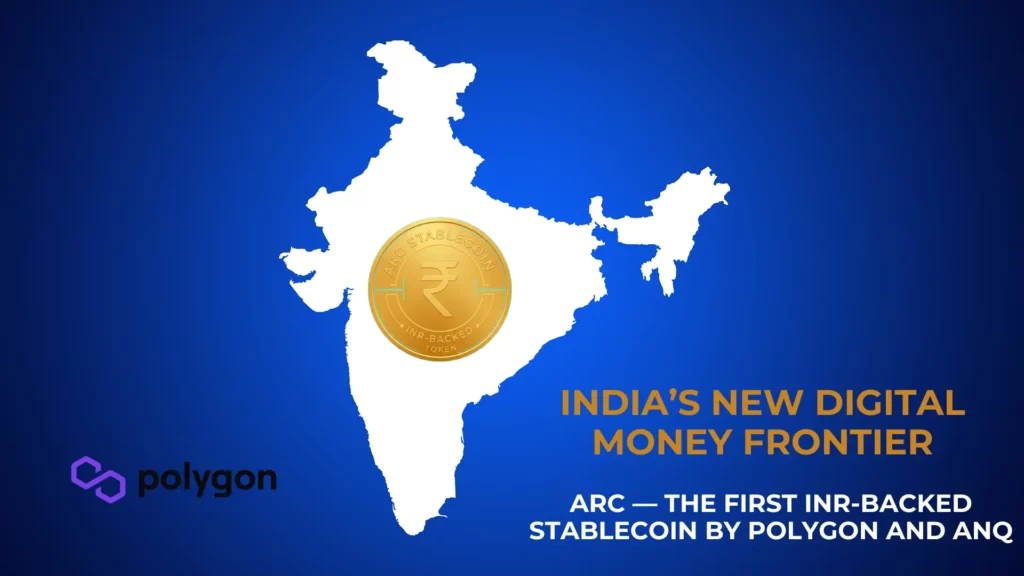
For years, India has watched global stablecoins like USDT and USDC dominate crypto markets — pegged to the US dollar and often moving Indian capital offshore. But now, things are about to change. Enter ARC: India’s first initiative toward a fully sovereign-backed, rupee-pegged stablecoin.
What is ARC?
- ARC stands for Asset Reserve Certificate — a proposed stablecoin designed to mirror the Indian rupee (INR) value on a 1:1 basis.
- Unlike dollar-pegged stablecoins, ARC will be backed not by foreign currency reserves, but by Indian sovereign assets: namely government securities and Treasury Bills.
- That means every ARC token issued is tied to real government debt — making it fully collateralized, non-speculative, and anchored within India’s financial system.
Who’s Building It — The Platform Behind ARC
- ARC is being developed by blockchain scaling network Polygon, in partnership with Indian fintech firm Anq.
- The aim is to build a compliant, regulated token — not a speculative crypto asset — that works alongside official digital currency infrastructure rather than replacing it.
- Specifically, ARC is envisioned to complement the official digital currency issued by the Reserve Bank of India (RBI) — the Digital Rupee (e₹) — by offering a programmable, blockchain-based layer for payments, settlements and finance operations.
🎯 Why ARC Matters: Key Benefits of a Rupee-Backed Stablecoin
| Benefit | What It Means for India & Users |
|---|---|
| Sovereign-backed stability | Since ARC is backed by Indian government securities, its value remains tied to the rupee — protecting users from dollar volatility and foreign currency exposure. |
| Keeps liquidity in India | Money stays within India’s financial system rather than flowing out via dollar-pegged coins. |
| Faster, cheaper payments & remittances | Stablecoins enable near-instant transfers, potentially reducing remittance costs (a major benefit for migrant workers and global Indian diaspora). |
| Programmable digital money | Using blockchain, ARC can enable smart-contract payments, automated business transactions, real-time settlements — bridging traditional finance with Web3. |
| Support for government funding & transparency | Every ARC issuance corresponds to government securities, potentially deepening India’s debt markets and creating transparent, regulated digital finance rails. |
| Complementary to Digital Rupee | ARC doesn’t replace the official Digital Rupee; instead it adds flexibility for fintech innovation while preserving central-bank control over money supply. |
When’s the Launch — Key Dates & What to Expect
- According to recent reports, ARC is slated for launch in the first quarter of 2026.
- The project is still under development — both regulatory oversight and technical infrastructure need to be finalised before public release.
At this time, no official public launch date, exchange list, or user-onboarding platform has been published. Think of it as “coming soon” — but likely among the most important developments in India’s fintech/crypto space.
Where You Could Buy or Use It — What’s Known (and What’s Not)
- Since ARC isn’t live yet, there are no confirmed exchanges or platforms where you can buy or trade it.
- Once launched, it’s expected to be available through regulated digital-asset exchanges or wallets — likely those that partner with Polygon and Anq.
- Because ARC will be fully backed by government securities and designed for compliance, usage will probably involve Know-Your-Customer (KYC) and Anti-Money Laundering (AML) norms, similar to other regulated digital assets.
- It may also be used for institutional-level settlements, trade finance, remittances, and possibly for individuals, depending on regulatory permission and adoption.
What’s Still Unclear — Risks and Open Questions
- Because ARC is backed by government securities, it’s arguable whether it behaves like a “traditional stablecoin” (i.e. directly redeemable to cash) or more like a tokenised debt instrument. The exact redemption mechanics remain to be clarified.
- The project — while promising — must still navigate regulatory, compliance, and technical hurdles. Until regulators publicly sanction it, everything remains speculative.
- Some voices in crypto argue the model is effectively centralised and similar to digital rupee (CBDC) rather than a permissionless crypto asset — potentially limiting decentralization benefits.
Conclusion: Why ARC Could Redefine India’s Financial Future
The upcoming ARC stablecoin — India’s first rupee-backed, sovereign-asset-based digital token — represents a significant shift. It has the potential to bridge traditional finance with blockchain, retain capital within India, lower remittance costs, enable programmable money, and support both retail and institutional transactions — all while aligning with national monetary sovereignty.
If all goes well, ARC could become a foundational element of India’s digital economy — the “digital rupee 2.0” that blends transparency, efficiency and sovereignty.
As India gears up for a January–March 2026 debut, this is one development worth watching closely.

I am Pawan Kashyap currently living in Amritsar. I always try to grab new things from the cryptocurrency market. From my observations and trends in the market, I always try to provide the best and accurate information in the form of articles from this blog. Follow us on Facebook, Instagram, and Twitter to join us.